What Is a Golf Cart DMS? A Buyer's Guide for Dealers
A golf cart DMS runs your inventory, your website and your service work. What it has to do that an auto system cannot, and the questions to ask any vendor.
TL;DR. A golf cart DMS is the system that holds your inventory, your deals and usually your service work. Most of the ones sold to cart dealers were designed for cars, RVs or powersports and adapted afterward, and that shows up in small ways that cost real money: no field for battery chemistry, no way to flag an LSV, a website run by a second vendor who has to be emailed before a price changes. Before you sign anything, ask to see a unit record, ask who can change your website, ask what it costs at six users, and ask what happens to your data if you leave. PowerDash was built for golf carts from the first screen, and the storefront and the DMS are one system the dealer controls. It is $599 a month flat with a 60-day free trial.
What a golf cart DMS actually is
A golf cart DMS is a dealership management system for a cart dealership. It holds your units, your customers, your deals and, in most shops, your service work. The good ones also run your website, because your inventory is what your website is mostly made of.
The term came over from the car business, where a DMS is one system among many and the store has people to hold it all together. A cart dealership does not work that way, which is why the same three letters mean something different here.
Why the choice is bigger in golf carts than in cars
I grew up in the family business, a franchise dealer group. I worked every job in the store, from the lowest rung up to General Sales Manager by the time the family sold it. In the car world there is a CRM vendor, a website vendor, a lead vendor, a desking tool and a factory system on top of all of it, and somebody on staff whose job is to keep that stack standing up.
A golf cart dealership does not have that person. There is an owner, a couple of salespeople, a service tech or two, and someone who handles the office. The software one of them picks on a Tuesday afternoon becomes how the whole business runs for the next five years. It is the inventory system, the website, the lead desk and the service board at once, which means the wrong choice does not cause one problem. It causes a small tax on every transaction, every day, and most dealers stop noticing it after a month.
That is the part worth slowing down for. You are not buying a tool. You are choosing how your shop works.
What a golf cart DMS has to do that an auto system does not
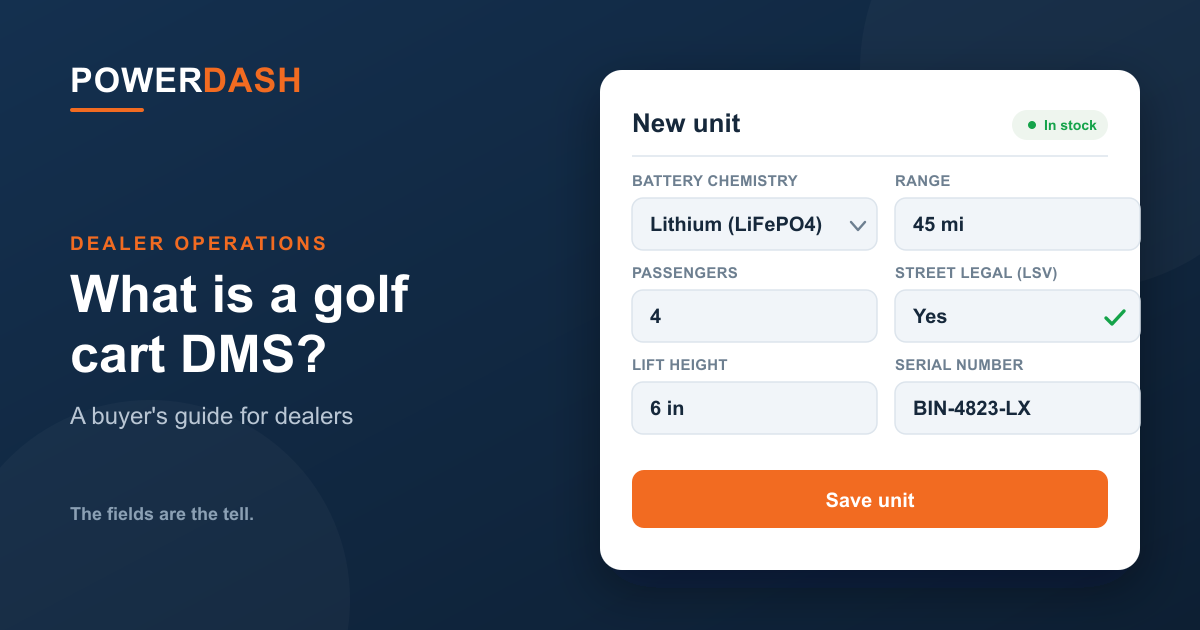
Here is the test I use. Open the software, start a new unit, and look at the fields.
A cart is not a car with a smaller engine. A buyer shopping your lot wants to know whether it is lithium or lead acid, how many passengers it seats, whether it is lifted, whether it is street legal in their town, and what the range is. Those are the first five questions on every call your salespeople take. In a system built for cars, none of them have a home, so they end up typed into a description box where nobody can filter on them and no search engine can read them.
Then look at what your customers see. Your website's filters come from those same fields. If your DMS has no field for battery chemistry, your site cannot offer a lithium filter, and the buyer searching for a lithium cart in your town lands on a page that makes him scroll through forty units to find three. Street-legal status is the same story, and if you are fuzzy on what makes a cart an LSV, that one distinction changes what you can sell and to whom.
Here is the vocabulary gap, need by need:
- Battery chemistry, pack size and range. An adapted system gives you a free-text description box.
- LSV versus standard cart, and the street-legal package. A checkbox borrowed from trim level, if anything.
- Lift height, tire and wheel package, seating for 2, 4 or 6. Options text nobody can filter.
- Serial number formats that are not 17-character VINs. A VIN field that rejects the number your OEM gave you.
- Used-cart intake with condition, hours and battery age. A trade-in screen built around mileage.
None of this is exotic. It is the vocabulary of the business. A system that speaks it saves a salesperson two minutes per unit and gives your website something real to filter on. A system that does not turns your inventory into paragraphs. This is what cart-specific inventory fields are for.
The three places dealers get hurt
Your website belongs to somebody else. This is the big one. In most setups the DMS holds inventory and a separate company runs the website, and the two are stitched together with a feed. When you drop the price on a used cart, you change it in one system and wait for the other to catch up, or you email a vendor and wait two days. Want a promo page for a Memorial Day sale? That is a ticket. Want to fix a typo on your own About page? Ticket. Dealers accept this because it is how it has always worked, and it is the single thing I would change first.
Per-seat pricing punishes you for growing. Several systems in this category charge per user, sometimes with a minimum of three. Hire a salesperson in spring and your software bill goes up. Add a service writer and it goes up again. Run the math at the size you plan to be in two years, not the size you are today, because that is the number you will actually pay.
The contract is longer than the honeymoon. Read the term and the exit clause before the demo makes you comfortable. Multi-year agreements with early termination penalties exist in this category, and the time to discover that is now, not in month fourteen when the software has not shipped anything you were promised.
The questions to ask any vendor before you sign
Print this list and take it to every booth. Vendors answer these differently, and the differences tell you everything.
- Show me a unit record. Not a slide. The actual screen where a cart gets added. Count the fields that are specific to carts.
- Who changes the price on my website, and how long does it take? If the answer involves a support ticket, you have two vendors and a delay built into every price move.
- What does it cost at six users? Ask for the total, monthly, with every module you just saw in the demo.
- What is the contract term and what does it cost to leave? Get the number, not a reassurance.
- Can I export everything, including photos, whenever I want? Your inventory and your customer list are your assets. A vendor who hesitates here has told you how the relationship ends.
- What is on the page today that is not actually built? Every platform has a roadmap. The good ones will tell you which parts are shipping later without being cornered into it.
Once you have asked them, see how the systems compare.
Built for carts, not adapted to them
That last question is one I have to answer myself, so here it is plainly.
PowerDash was built for golf cart dealers from the first screen. The inventory fields are the ones above, not auto fields with new labels. The filters your buyers use are battery chemistry, LSV, lift and passenger count because those are the questions they ask. Your storefront and your inventory are the same system, so adding a cart puts it on your site, and changing a price changes it everywhere, in the time it takes to type the number.
That last part is the reason the company exists. I have spent almost ten years marketing golf cart dealerships, and the pattern that made me build software was watching good operators wait on a vendor for permission to run their own promotion.
Here is where we are, plainly. The website, the inventory system, the content tools, the service side, CRM and pipeline, rentals, the parts store and the AI chat agent are all shipped and running in dealer accounts today. Our pricing page lists exactly what is included, and I would rather you read it before you buy than find out in month two.
It is $599 a month, flat, for the whole dealership. Unlimited users, no contract, and you can export everything any time, including the day you decide to leave. You can take 60 days to try it with your own carts in it.
FAQs
What is a golf cart DMS?
A dealership management system for golf cart dealers. It holds your inventory, your deals, your customers and usually your service work in one place. A golf cart DMS differs from an automotive one in the unit record itself, because a cart is described by battery chemistry, passenger count, lift and street-legal status rather than by mileage and trim.
What does a golf cart DMS cost?
It varies by pricing model more than by feature set. Per-user systems in this category commonly run $130 to $390 a month for a small shop and climb with each seat. Enterprise automotive platforms adapted for carts run higher and are usually quote-only. PowerDash is $599 a month flat with unlimited users and no contract.
Can I run a golf cart dealership on an automotive or powersports DMS?
You can, and plenty of dealers do. The cost shows up in the details: cart-specific attributes end up in description text, your website filters cannot use them, and you work around a VIN field that was not built for your serial numbers.
Does a golf cart DMS include my website?
Usually not. Most dealers run a DMS from one vendor and a website from another, connected by an inventory feed. That split is why price changes and new pages take days. Some platforms, PowerDash included, run both as one system.
What inventory fields does a golf cart dealer actually need?
Battery chemistry and pack details, range, passenger capacity, lift height, tire and wheel package, LSV or street-legal status, serial number, condition and hours for used units, plus photos. Those fields drive your website filters, so they matter beyond the back office.
How long does it take to switch systems?
The work is mostly inventory. If you can export your current units to a spreadsheet, a switch takes days rather than weeks. Ask your prospective vendor whether they will do the import for you and what they need from you to start.
Do I need a DMS if I only sell ten carts a month?
At ten units a month the inventory is manageable on a spreadsheet. What is not manageable is the website, the leads and the service tickets living in three different places. Smaller shops usually feel the pain on the marketing side first.
What should I ask a DMS vendor at a trade show?
Ask to see a real unit record, ask who changes prices on your website and how long it takes, ask the total cost at six users, ask the contract term and the exit cost, and ask what on the page is not built yet.
See it running with your own carts in it
PowerDash is $599 a month flat, unlimited users, no contract, and the first 60 days are free. Start your free trial, or see the full feature set first.