Golf cart web design in 2026: what actually converts buyers
What a golf cart dealer website needs to convert in 2026. Inventory filters that match how buyers actually shop, mobile-first rules, Lighthouse targets, and three ways to build it without burning a quarter on plugins.
Most golf cart dealer websites we audit haven't been touched since 2018. Grainy hero photo, "Call for price" everywhere, no filtering on the inventory page, broken on a phone. Then the dealer wonders why the leads don't come in.
Good golf cart web design isn't about looking pretty. It's about doing four things in this order: load fast, surface inventory, qualify the buyer, and capture the lead before they leave the page.
Here's what every dealer website needs in 2026, what the build options actually cost, and the performance targets we use across the Powerdash customer base.
Why most golf cart dealer websites underperform
The pattern is the same on every audit we do.
- Slow. Average Lighthouse mobile score on a Dealer Spike or WordPress dealer site is in the mid-30s. Buyers on a phone bounce inside three seconds.
- Inventory is hidden. The home page has a stock photo and a phone number. The actual inventory takes two clicks to reach and renders as a thumbnail grid with no filters.
- "Call for price." Hiding prices was a 2010 tactic. Today's buyer expects to see the number on the page or they're gone.
- No mobile thought. 70 to 80% of dealer site traffic is on a phone. Half of the sites we audit look like a 2014 Joomla theme on mobile.
- No lead pipeline. The only conversion path is a phone number. Form submissions go to an inbox no one checks.
Fixing those five things almost always doubles inquiries in 30 days. We've watched it happen dozens of times.
The 7 sections every golf cart dealer website needs
1. A home page that puts inventory above the fold
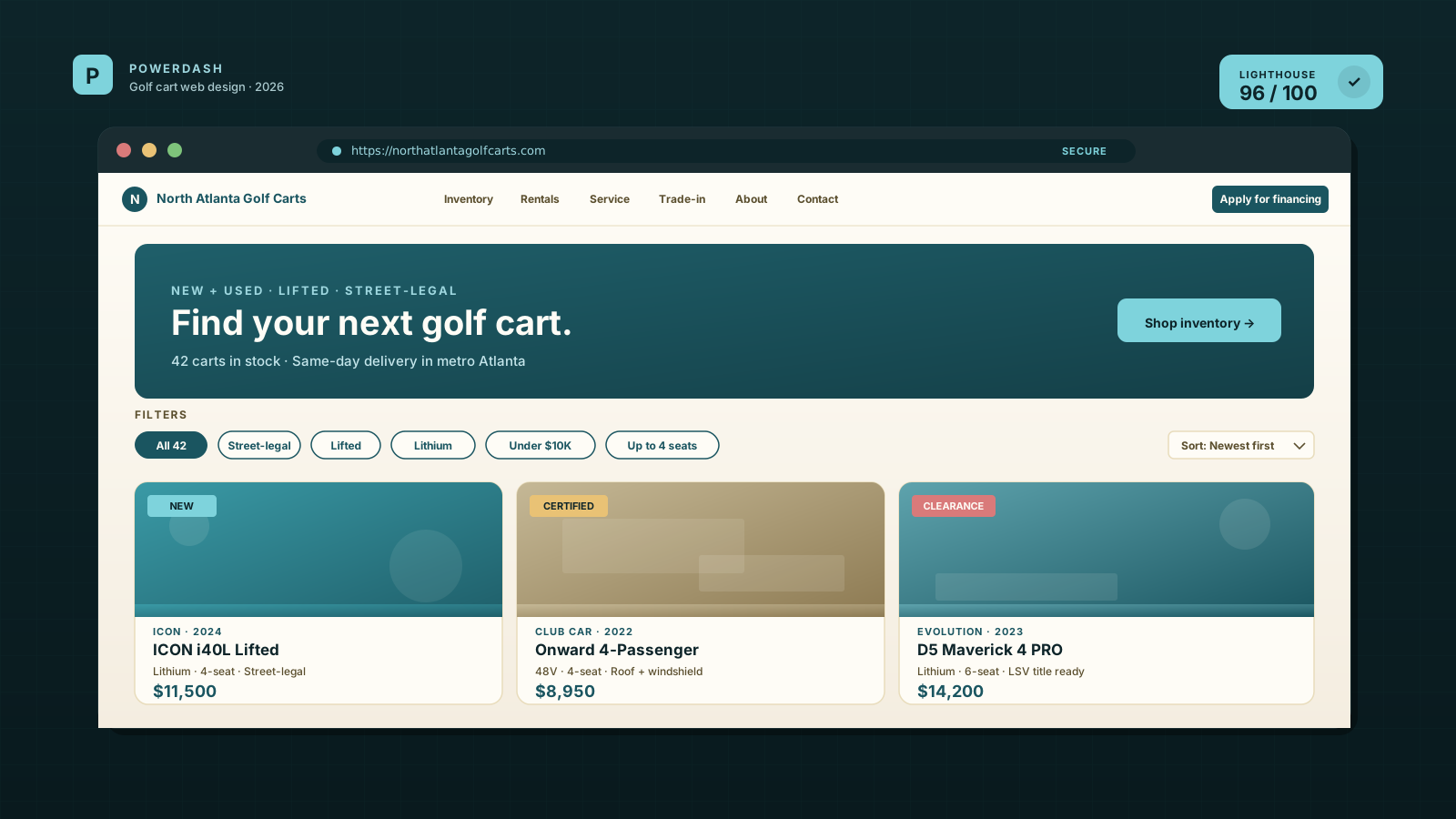
Your hero shouldn't be a stock photo of a beach. It should be a fast statement (who you are, where you are, what's in stock right now) plus a clear path into the inventory. Bonus: surface 3 to 6 featured units directly on the home page so they're indexed and findable without a click.
2. An inventory page with real filters
Generic e-commerce platforms (looking at Shopify) treat every product as a SKU with a price. That's wrong for carts. Each unit has a stock number, condition, battery chemistry (lead-acid vs lithium), LSV / street-legal status, lift height, seating capacity, and color. Buyers filter on those. If your site doesn't let them, they leave for one that does.
The non-negotiable filter set in 2026: condition, battery, street-legal, seating, price range, lift. Add make/model only if your inventory crosses 5+ brands.
3. Per-unit detail pages with everything
Each unit page needs: high-res photo gallery (6 to 10 images, not 2), full spec table, financing calculator, lead form, similar units module. Schema markup for product + offer so Google can serve it in shopping carousels. Mobile sticky CTA so the "Check availability" button never falls off screen.
4. A rentals page that takes bookings online
If you do rentals, a "call us" page isn't a rental page. You need real-time per-unit availability, date pickers, deposit handling, and confirmation emails. We wrote about this at length in the six things rental software keeps getting wrong.
5. Trade-in and financing forms that work on a phone
Two-step forms. Big touch targets. Phone keyboard for phone fields, ZIP keyboard for ZIP fields. Auto-format VIN. Validate before submit. Send to your CRM and notify your sales rep in under a minute. Most dealer sites botch this.
6. Service / repair landing
Half your existing customers come back for service. A service page should have: hours, fenced service area on a map, current wait time, online booking, and your most-common service prices. Adding online service booking has tripled service revenue for two dealers we work with.
7. About, contact, and trust signals
Boring but load-bearing. Address with a real map, the team photos (not stock), Google review average pulled live, years in business, a "Why us" section with 3 specific reasons (not "great service"). This is where the buyer decides whether to drive to your lot.
Five mobile-first rules
If your traffic is 70%+ on mobile (it is), your design loop has to start on a phone.
- One-thumb reachable CTA. The main action lives in the bottom 40% of the viewport.
- Inventory filters as a sheet, not a dropdown. Slide up from bottom, full-screen.
- Tap targets at 44 pixels minimum. Anything smaller is unusable with a thumb.
- No horizontal scroll on any page. Ever. Audit weekly.
- Forms that don't ask for unnecessary fields. Name, phone, what you're looking for. Email is optional. Anything else lives on the second touch.
The Lighthouse targets we hold ourselves to
If your site is fast, half your conversion problem is solved. The targets we ship every Powerdash storefront against:
- Performance: 90+ on mobile, throttled. The single biggest factor.
- Accessibility: 95+. Free SEO win, and the right thing to do.
- Best practices: 95+. Mostly about modern image formats and not loading garbage.
- SEO: 100. Required, not optional.
- Largest Contentful Paint under 2.5 seconds on mid-range Android.
For comparison: median Dealer Spike site in 2026 scores 34 on mobile performance. Median DX1 site scores 41. Median WordPress dealer site (with the standard 15-25 plugins) scores in the high 30s. The math is not subtle.
Three ways to build a golf cart dealer website (with real costs)
Option A: Hire a freelancer or agency to design WordPress
Cost: $4,000 to $15,000 upfront. Plus $50 to $150 a month in hosting, plugins, maintenance. Plus your time when something breaks.
Pros: total control, you own everything, lots of WordPress agencies to hire.
Cons: you'll spend a weekend a month maintaining it, performance varies wildly, and inventory integration with a DMS is usually a custom job. Full WordPress alternative comparison.
Option B: Use Shopify or a generic site builder
Cost: $30 to $300 a month plus 2 to 3% transaction fees plus app fees. Total typically $200 to $500 a month all-in once you add the apps you need.
Pros: fast to launch, modern templates, predictable hosting.
Cons: the schema fights you (each cart wants to be a SKU, but they're per-unit assets with VINs), no rentals, no trade-in pipeline, no real lead routing. Fine for parts and accessories, wrong for sales inventory. Full Shopify alternative comparison.
Option C: A purpose-built dealer platform (Powerdash)
Cost: $0 for 60 days, then $499 flat per month. No setup fee, no transaction fees on sales, no per-photo or per-page charges.
Pros: built specifically for golf cart dealer schema (unit-level inventory, LSV status, battery filters), Lighthouse 90+ out of the box, rentals + trade-in + financing forms native, free migration help on day one, no plugin tax.
Cons: less template flexibility than WordPress, by design. The trade-off is the next 100 hours of your year.
If you want the full landscape (every option side by side), our 2026 dealer software field guide covers every major DMS plus the DIY options. And if you're starting from scratch, our honest playbook on starting a dealership walks through every cost line item.
The fastest way to know if your current site is the problem
Three checks. Free. Five minutes.
- Run your home page through PageSpeed Insights on mobile. If you score below 60, you're losing leads to bounce.
- On your phone, try to filter inventory to "lithium, lifted, under $12K." If it takes more than two taps to see results, your site is the bottleneck.
- Submit a lead through your own form. Time how long until you (the dealer) actually hear about it. If it's more than 60 seconds, the buyer has already messaged your competitor.
If any of the three fail, you don't need a new logo. You need a new site.
The TL;DR
- Golf cart web design is dealer-schema-first. Generic builders fight you.
- Mobile-first, Lighthouse 90+, real inventory filters, live booking, sub-60-second lead routing.
- WordPress works if you have a developer. Shopify is fine for parts only. Hiring out costs $4K to $15K.
- Powerdash builds all of the above into the box for $499 flat per month. Start the 60-day trial. No card.
And if you want every other Powerdash-vs-alternative breakdown, the compare hub covers every option golf cart dealers actually consider.